You step off the plane, head to the baggage carousel, and your suitcase never shows up. Or, you do get your bags, but they're damaged, or something is missing. If this happens, there's a very important step to take: filing a Property Irregularity Report (PIR).
The PIR is a simple report that officially tells the airline that something went wrong with your luggage, whether it's delayed, lost, or damaged. It also creates a delayed or lost baggage tracking case, so the airline can start searching for your bag.
Let's get into all the need-to-know PIR details. You'll understand why the Property Irregularity Report is the first and most important move when your luggage is mishandled. Then, if the worst does happen, you'll be prepared to meet all the PIR requirements.
Key Takeaways
Click each item to mark as read
- 1✓
File your PIR at the airport before leaving - every hour you wait weakens your case.
Airport staff can inspect damage firsthand, your bag is still visible in the system, and the case opens immediately. Online reports filed the next day carry significantly less weight.
- 2✓
Your PIR reference number is the only way to track your bag through WorldTracer.
WorldTracer (worldtracer.aero) is the global baggage tracing network used by 400+ airlines. Without a PIR number, your bag has no formal record in the active search system.
- 3✓
A PIR starts the process - it does not guarantee compensation. Claims are filed separately.
Many passengers confuse the PIR with the compensation claim. The PIR logs the problem; the written compensation claim submitted separately to the airline is what triggers payment.
- 4✓
Two strict deadlines: 7 days to report damage, 21 days to file a delay claim.
These come directly from the Montreal Convention, which applies to most international flights. Missing either deadline gives the airline legal grounds to reject your claim outright.
- 5✓
Even if your bag returns, keep the PIR - you may still need it for damage or missing items.
Bags sometimes come back with broken wheels, cracked shells, or missing contents. An active PIR means you can immediately escalate to a damage claim without starting from scratch.
What is a Property Irregularity Report?
An easy rule to remember about the PIR is that if you want to get your bags back or claim compensation, you need one. Here's what you need to know:
The PIR is an official form that passengers must complete when baggage problems arise. It creates a traceable record of the issue (and the luggage).
Airlines rely on PIRs to log problems in their baggage management systems. Once the report is created, the case is entered into a global tracing network used by many airlines and airports worldwide.
A PIR is typically completed when a bag does not arrive on the same flight, is delivered in damaged condition, or can't be located at the airport baggage carousel.
After filing the report, passengers receive a unique PIR reference number. This code allows both the airline and the traveller to track updates while the airline searches for the bag.
Most travellers complete the report in person at the airline's baggage service counter before leaving the airport, although some airlines also allow PIRs to be submitted online shortly after arrival.

When you need to file a PIR
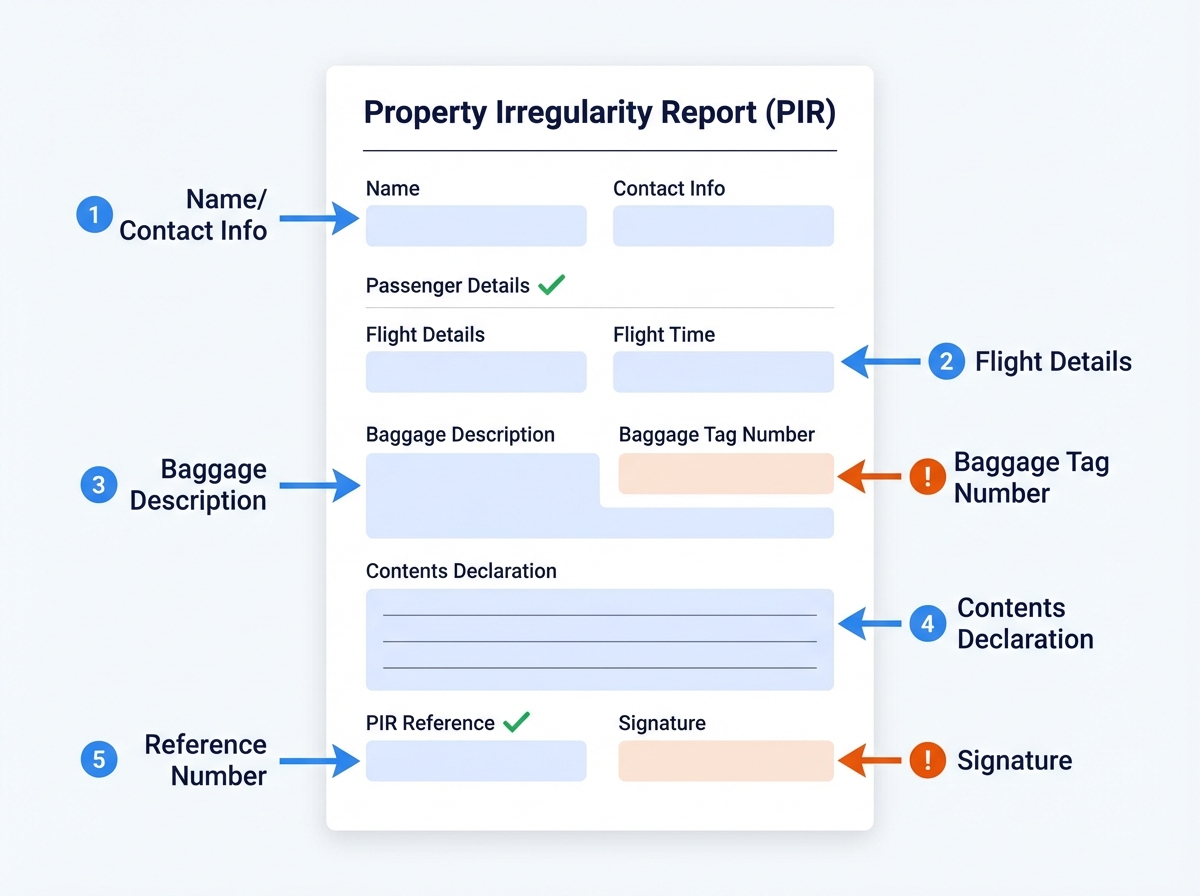
File a Property Irregularity Report anytime something goes wrong with your checked baggage during a flight. Do this before you leave the airport whenever possible.
Delayed baggage
Delayed baggage occurs when your luggage doesn't arrive on the same flight as you. This is one of the most common reasons passengers file a PIR.
At the airport, airline staff will create the report or use the info you provide online to enter details about your bag into the airline's tracing system. These details include:
- Size
- Colour
- Brand
- Baggage tag number
This is what starts the locating process. If you're lucky, and it's found, the airline will arrange delivery once it arrives at the airport.
Lost baggage
The good news is that most delayed luggage is found within 3 days of going missing. But passengers need to wait for the airline to officially say the bag can't be found. That's when it becomes lost luggage. The length of time it takes depends on the airline, but in general:
Europe - Most airlines will declare your baggage lost after 21 days.
USA - On average, airlines will declare your bags lost after 5-14 days.
To be eligible for lost luggage compensation, you need to have first filed a PIR for delayed luggage within 7 days of the flight.
Damaged baggage or missing items
A PIR can also be used to document luggage that arrives broken, torn, or otherwise damaged during the flight. This may include:
- Cracked suitcase shells
- Damaged wheels or handles
- Anything missing from the bag
How to file a Property Irregularity Report
File it online or at the airport
Luckily, filing your PIR should be relatively quick and straightforward. With most airlines, passengers have the option to complete the report in person at the baggage services desk or online.
Remember that your bags are first considered delayed and then declared "lost" after sufficient time passes. You won't find a lost luggage PIR, only one for delayed bags.
If using the airline's online portal, simply enter your information and follow the prompts. At the end, you'll receive the all-important tracking reference number.
Filing your PIR in person at the airport
Go to the airline's baggage service desk at the airport. After realising your bag is missing or damaged, head to the airline's baggage services counter near the baggage claim area. This is where airline staff handle luggage issues and create the PIRs.
Provide your boarding pass and baggage tag. Staff will ask for your boarding pass and the baggage tag attached to your ticket or luggage receipt. These details help the airline identify your bag in the tracking system.
Describe the bag and its contents. To help with tracking down your delayed luggage, you may be asked to describe the suitcase (colour, size, brand, wheels, stickers, etc.) and sometimes list a few typical items inside. This helps baggage tracing systems identify the bag if it turns up somewhere unexpected.
Receive your PIR reference number. Once the report is filed, you'll receive a PIR reference code. This is the case number used to track updates and communicate with the airline about your baggage.
Track the suitcase through the airline's baggage system. Many airlines allow you to track the status of your bag online using the PIR number. Updates may show when the bag is located, transferred, or scheduled for delivery.
PIR & Claim Deadlines in Europe, the UK, and North America
Unfortunately, there isn't a single deadline for filing your PIR that applies to all airlines or all regions. What works every time is filing your Property Irregularity Report immediately after you realise the mishandling has occurred. Here's what to expect, generally:
Europe and the UK (Montreal Convention)
For flights involving Europe or the UK, international rules generally require passengers to report issues within specific timeframes:
Damaged baggage: within 7 days of receiving the luggage.
This is generally true for major, global airlines like British Airways, Air France, and KLM. Low-cost carriers may be more strict on domestic flights - for example, easyJet requires notice of damage within 24 hours.
Delayed baggage: written claims typically must be submitted within 21 days of receiving your bags.
The initial PIR must still be filed when the bags don't arrive with you.
United States and Canada
In the United States and Canada, baggage reporting deadlines are usually set by individual airlines. Note that international flights to or from North America are also covered by the Montreal Convention.
Typical guidelines for domestic flights include:
- Reporting delayed baggage immediately at the airport
- Reporting damage within 24 hours (common) to a few days, depending on the airline
- Following airline-specific procedures for reimbursement or claims
Because airline policies can differ, the best advice is to report the issue as soon as possible.
What happens after a PIR is filed?
Once the PIR is submitted, the airline begins the process of locating your luggage and resolving the issue. You can expect the following:
Airline begins baggage tracing - The report enters the airline's global baggage tracing system, allowing staff to search for the bag across airports and partner airlines.
Essential item reimbursement - Airlines are required to provide delayed baggage compensation. They need to reimburse reasonable purchases, such as clothing or toiletries, while you wait for delivery.
Bag delivery - Once located, the airline should deliver your checked bags to your home or hotel. This saves you the hassle of returning to the airport.
Lost luggage claims - In the event the airline never finds your baggage, you'll need to initiate a compensation claim with them for the contents.
CTA: Need help getting reimbursed for lost luggage? We can help. Star a claim here.
Common mistakes to avoid
You don't want to make baggage claims harder to resolve or delay the delivery. Don't risk making these mistakes:
- Leaving the airport without filing a PIR
- Losing the baggage tag
- Waiting too long to report damage
- Providing incomplete contact information
Leaving the airport without filing a PIR
This is one of the most common problems. If you don't file a PIR, the airline doesn't know your bag is missing. You'll delay getting it back safely and might jeopardise any subsequent compensation or reimbursement claims.
Losing the baggage tag
The tag number helps airlines trace your bag in their system, so keeping it can make the search process much easier.
Waiting too long to report damage
Airlines often enforce strict deadlines for reporting damaged luggage. The safest bet is to report the damage to the airline within 24 hours of the flight. Check your suitcases thoroughly before leaving the airport to be even safer.
Providing incomplete contact information
Make sure the airline has the correct phone number, email, and delivery address. If they can't reach you, you'll definitely delay getting your bag back.
What to remember about PIRs
If your luggage is delayed, lost, or damaged, filing a Property Irregularity Report is the first step toward resolving the issue. The report creates an official record with the airline and starts the baggage tracing process.
Whenever possible, file the PIR before leaving the airport, keep your reference number, and follow airline deadlines. Acting quickly helps protect your ability to track your bag and pursue compensation.