Key Takeaways
Click each item to mark as read
- 1✓
UK liquid rules vary by airport - some allow up to 2 litres, others still enforce 100ml.
Heathrow, Gatwick, Edinburgh, Birmingham, Bristol, and several others have upgraded to CT scanners. Stansted, Manchester, Luton, and others still apply the 100ml rule.
- 2✓
Your return airport may have different rules to where you departed from.
Just because your outbound airport allows larger liquids doesn't mean your destination does. Always check the rules at the airport you're flying home from before you pack.
- 3✓
Medications, baby food, and special dietary items are exempt from liquid restrictions.
These are exempt at all UK airports regardless of the 100ml rule. You may be asked to show proof, such as a prescription or the product packaging, so keep documentation accessible.
- 4✓
Lithium batteries in checked bags are restricted - most must go in hand luggage.
Spare lithium batteries and power banks must travel in carry-on, not checked baggage. Airlines and airports can confiscate them at the gate if found in your hold luggage.
- 5✓
Always verify current rules on your airport's website before you travel.
Security technology and liquid policies are still changing. Airport upgrades happen without much public notice, and rules can change between when you book and when you fly.
Important for return journeys: Just because your departure airport has lifted the 100ml rule doesn't mean your return airport has. Many airports abroad, including popular holiday destinations, still enforce the old rules. Always check before you fly home.
What counts as a liquid?
Where the 100ml rule still applies, the following all count as liquids and must comply with current cabin bag rules:
- Toiletries: shampoo, conditioner, moisturiser, shower gel
- Makeup: foundation, lip gloss, mascara
- Aerosols: deodorant, hairspray, dry shampoo
- Toothpaste and mouthwash
- Perfume and aftershave
- Contact lens solution
- Honey, jam, peanut butter, hummus, yoghurt, and similar spreadable or semi-liquid foods
Exemptions at all airports regardless of the rule in place
The following are exempt from liquid restrictions at all UK airports:
- Liquid medicines: quantities over 100ml permitted with a prescription or GP letter
- Baby milk, formula, and baby food: exempt for the duration of the journey; declare at security
- Breast milk: permitted whether or not your baby is travelling with you
- Duty-free liquids: permitted if sealed in a security bag with the receipt visible inside
Airports where the 100ml rule has been lifted (up to 2 litres permitted)
Heathrow, Gatwick, Edinburgh, Birmingham, Bristol, Belfast International, Belfast City, and Bournemouth have upgraded to new CT security scanners.
At these airports, passengers can leave liquids in their cabin bags and carry containers of up to 2 litres through security. You no longer need to remove liquids from your hand luggage or pack them in a clear plastic bag.
Airports where the 100ml rule still applies
At London Stansted, Manchester, London Luton, London City, Glasgow, Newcastle, Liverpool, Leeds Bradford, East Midlands, Aberdeen, Cardiff, and Southampton, the 100ml rule still applies. Although, at most of these airports you no longer need to remove liquids from your bag for screening.
Important
Always check the latest rules for your departure airport before you travel. Security technology and liquid policies are still changing, and your return airport may still enforce the standard 100ml rule even if your outbound airport does not.
Which rule applies at your airport?
*This table reflects the position as of March 2026 but the rollout is ongoing. Always verify the current rules on your specific airport's website before you travel, as airports can upgrade without much public notice.
Batteries: the rules that catch people out
Batteries are one of the most misunderstood areas of hand luggage policy because most passengers have never had to think about them.
Standard, non-lithium batteries (AA, AAA, C, D, 9V, button cell) are permitted in both hand luggage and checked baggage, provided they're packed to prevent short-circuiting. Keep them in their original packaging or use a battery case.
Lithium batteries are where it gets more specific:
Loose lithium batteries must travel in hand luggage only. They are never permitted in hold baggage due to fire risk
Lithium batteries installed in devices (phones, laptops, cameras) can travel in either hand or hold luggage
Spare lithium batteries over 160Wh are generally prohibited in both cabin and hold on commercial flights, but check with your airline for specific equipment
This rule exists because lithium battery fires are more easily detected and managed in the cabin than in the hold.
Electronics
Most portable electronics are permitted in hand luggage, including:
- Laptops and tablets
- Mobile phones and cameras
- Electric razors and hair dryers
- Portable chargers and power banks (subject to lithium battery rules above)
- Headphones and earbuds
At airports with new CT scanners, you no longer need to remove laptops and other electronic items from your bag at security. At airports without them, you'll still be asked to take them out and place them in a tray separately.
Drones occupy a grey area. Airlines have their own policies on whether they're permitted in the cabin, so check directly with your carrier before travelling.
E-cigarettes and vapes
Vaping and smoking are prohibited on all commercial flights, but what catches people out is the rule around carrying these devices.
E-cigarettes, vape pens, and any device containing a lithium-ion battery are a safety risk and must be kept in your hand luggage. These items are expressly prohibited from checked baggage.
E-liquids are subject to the standard liquids rule: 100ml containers at airports where that rule still applies.
FYI: Single-use disposable vapes have been banned for sale in the UK since June 2025. You can still travel with devices purchased legally, but they must remain in hand luggage.
Sharp items
Anything that could be used as a weapon won't get through security. This means certain sharp knives, ammunition, guns, and some scissors are banned from being taken into the cabin of the plane, whether in hand luggage or on your person.
If you're ever in doubt, pack it in your checked bag, wrapped safely to protect baggage handlers.
Food
Dry, solid food is generally fine in your hand luggage. Complications only arise in two specific situations.
Foods that are liquid or gel-like: yoghurt, peanut butter, hummus, jam, soft cheese, honey all fall under the liquids rule where it applies and must be in containers of 100ml or less.
Foods subject to import restrictions, and this is where it gets particularly important for UK passengers.
There are now significant food restrictions for both inbound and outbound UK flights.
Travelling from the UK to the EU: The EU prohibits passengers arriving from non-EU countries (including Great Britain post-Brexit) from bringing meat and dairy products into the region.
Returning to the UK from the EU: Since 12 April 2025, bringing meat or dairy products from any EU country into Great Britain has been illegal. This includes sandwiches, cured meats, cheese, and milk, whether packaged or bought at duty-free. If you get caught with these products you can be fined up to GBP 5,000.
These rules can change, so always check GOV.UK before you travel.
Sports and outdoor equipment
Most sports equipment is not permitted in the aircraft cabin but only because items like ski poles or hockey sticks could be used as weapons or are just too large for the cabin's limited space.
A note on walking sticks: Standard walking sticks and crutches used as mobility aids are permitted in the cabin and typically do not count towards your hand baggage allowance. This is different from collapsible trekking or hiking poles, which must go in the hold.
Firearms and ammunition
In the UK, the rules on travelling with firearms are far stricter than in many other countries. Civilian ownership of most firearms is heavily restricted, and the rules for travelling with them are just as strict.
Firearms and ammunition are absolutely prohibited in hand luggage. If you are legally authorised to travel with a firearm as checked baggage, for example, as a licensed sport shooter, you must:
- Declare the firearm to your airline before check-in
- Transport it in a hard-sided, locked container in the hold
- Comply with both UK departure rules and the destination country's import regulations
- Carry supporting documentation for the firearm
For more specifics, contact your airline and the UK Civil Aviation Authority well in advance of travel.
What to always keep in your hand luggage
Even if you plan to check your main bag, there are certain items that should always travel with you in the cabin, both for security and because airlines can lose or delay baggage.
Keep these items in your hand baggage:
- Medications, including all prescription and essential over-the-counter medicines, including a sufficient supply for delays
- Valuables, like jewellery, cameras, laptops, and anything irreplaceable
- Important documents, such as your passport, travel insurance details, accommodation bookings
- Cash, in a reasonable amount in the relevant currency
- A change of clothes, particularly useful if your checked bag is delayed
- Basic toiletries to get through a night if your bag doesn't arrive
Tip
If your checked bag is delayed on an international trip, you can often reclaim reasonable essentials later, but that reimbursement takes time. Keeping basic toiletries, medication, and one change of clothes in your cabin bag gives you a much safer fallback.
A note on airline size and weight rules
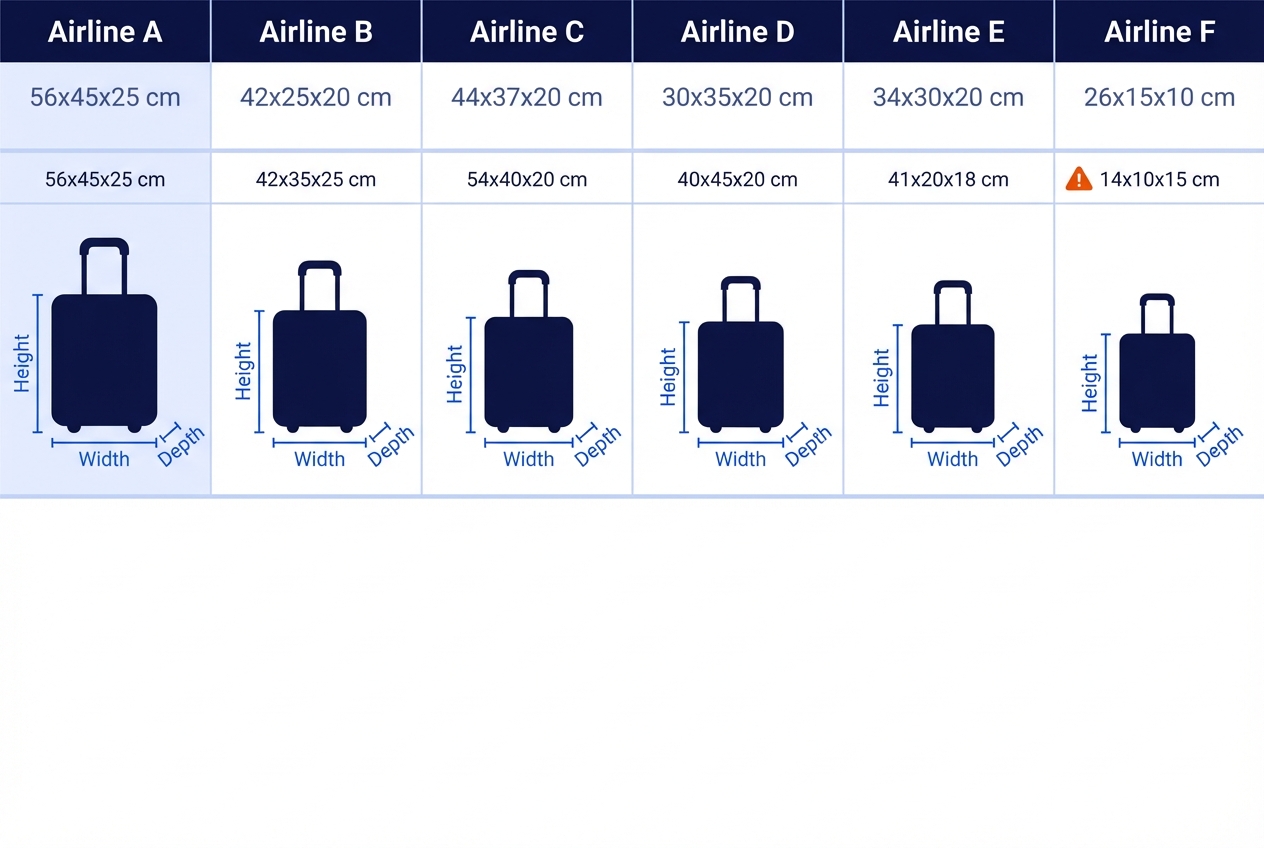
The size and weight of hand baggage varies according to the airline and aircraft type. Always check your baggage allowance in advance with the airline. Some carriers will require you to check in bags that are too large to be hand luggage, and many will charge you to do this.
Budget carriers in particular have tightened their cabin bag policies, with some now charging for bags that exceed your personal item allowance. If your bag doesn't comply with the rules, you may be asked to check it at the gate, and that means you'll have to pay hold baggage fees plus the risk of delay or damage.
FAQs
Yes, but it depends on your departure airport. At airports with new CT scanners (Heathrow, Gatwick, Edinburgh, Birmingham, Bristol, Belfast, and Bournemouth), you can carry up to 2 litres. At other UK airports, the 100ml rule still applies. Always check your specific airport's rules before you travel.
Not at airports with new CT scanners. At Heathrow, Gatwick, Edinburgh, Birmingham, Bristol, Belfast, and Bournemouth, you can leave your laptop in your bag. At other UK airports, you'll still need to remove it and place it separately in the security tray.
Yes, e-cigarettes and vapes must travel in your hand luggage only. They are expressly prohibited from checked baggage due to the lithium-ion battery fire risk. E-liquids are subject to the standard liquids rule (100ml at airports where that rule applies).
Loose lithium batteries must travel in hand luggage only, never in the hold. This is because lithium battery fires are more easily detected and managed in the cabin. Lithium batteries installed in devices (phones, laptops, cameras) can travel in either hand or hold luggage.
Dry, solid food is generally fine. However, foods that are liquid or gel-like (yoghurt, peanut butter, hummus, jam) fall under the liquids rule. Additionally, there are now significant restrictions on bringing meat and dairy products into the UK from EU countries since 12 April 2025, with fines up to GBP 5,000 for violations.
If your hand baggage exceeds your airline's size limits, you may be asked to check it at the gate. This can result in hold baggage fees and the risk of delay or damage. Budget carriers in particular have tightened their cabin bag policies. Always check your specific airline's allowance in advance.
Yes, standard walking sticks and crutches used as mobility aids are permitted in the cabin and typically do not count towards your hand baggage allowance. However, collapsible trekking or hiking poles must go in the hold.
Always keep medications, valuables (jewellery, cameras, laptops), important documents (passport, insurance, bookings), cash, a change of clothes, and basic toiletries in your hand baggage. If your checked bag is delayed, you'll be glad you have these essentials with you.
Sources
- UK Government - Hand luggage restrictions at UK airports
- UK Government - Hand luggage restrictions: liquids
- UK Government - Hand luggage restrictions: electronic devices
- UK Government - Personal meat import restrictions
- UK Government - Meat and dairy product guidance
- UK Civil Aviation Authority - What items can I travel with
- UK Civil Aviation Authority - Checking baggage allowance
- UK Civil Aviation Authority - Baggage guidelines
- British Airways - Restricted and prohibited items
- London Stansted Airport - Security
- Edinburgh Airport - Hand luggage rules explained
- IATA - Dangerous goods regulations