Last updated · Facts checked against official sources
Here is how to file a Property Irregularity Report (PIR): go to your airline's baggage service desk in the arrivals hall before you leave the airport, show your boarding pass and bag tag receipt, describe the bag and its contents, check your contact details and leave with a file reference number. Filing is free and usually takes a few minutes.
This guide walks through each step, every field on the form, what changes for damaged bags, and the mistakes that weaken a claim later. If you only need to know what a PIR is and why it matters, read our short PIR explainer.
Key Takeaways
Click each item to mark as read
- 1✓
File your PIR at the airline's baggage desk before you leave the airport.
Staff can see the damage or confirm the bag is missing while you are there, and the case opens straight away. A report made later is weaker evidence.
- 2✓
Leave with the file reference number and a copy of the report.
The reference is how you track the bag, update your file and link receipts to your claim. Photograph the report before you leave the desk.
- 3✓
A PIR records the problem. It is not a compensation claim.
The written claim you send to the airline afterwards is what asks for money. Many passengers confuse the two.
- 4✓
Written claim deadlines: 7 days for damage, 21 days for delay.
These come from the Montreal Convention, which applies to most international flights. Missing them gives the airline grounds to reject your claim.
- 5✓
Keep the PIR even if your bag comes back.
Bags are sometimes returned damaged or with items missing, and you may have spent money while waiting. The PIR reference connects all of it.
What is a Property Irregularity Report?
A PIR is the airline's official record that your checked bag was delayed, damaged or arrived with items missing. It opens a tracing case and gives you a reference number. A lost bag starts as a delayed-bag PIR: there is no separate "lost" form.
How do I file a PIR at the airport, step by step?
- Stay in the baggage hall. Once you pass customs you may not be able to get back to the desk. Wait until the carousel has stopped and the last bags are off.
- Find your airline's baggage desk. It is usually next to the carousels and may be run by a handling agent on the airline's behalf. On a connecting trip, this is usually the airline that operated your last flight.
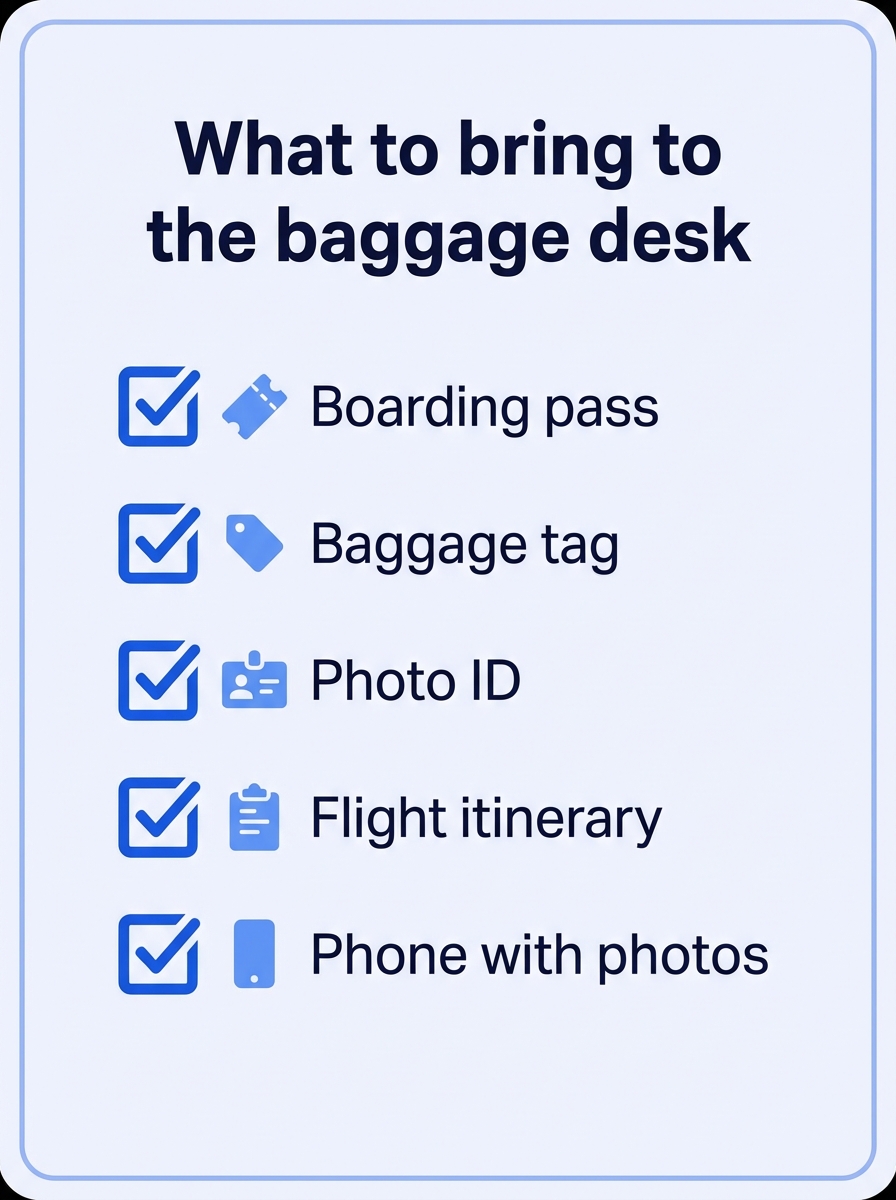
- Show your documents. Hand over your boarding pass and bag tag receipt so staff can look up your bag.
- Describe the bag precisely. Give the brand, colour, size, material and any distinctive marks. Show a photo if you have one.
- List some contents. Mention a few unusual items near the top of the bag. Tracing teams use contents to identify bags that have lost their tag.
- For damage or missing items, show staff the bag and ask them to record what is damaged or missing on the report.
- Check the report before you sign. Read back your name, phone number, email and delivery address. Ask for corrections on the spot.
- Leave with the reference and a copy. Photograph the report and the file reference, and ask how to track the case online.
What information goes on a PIR form?
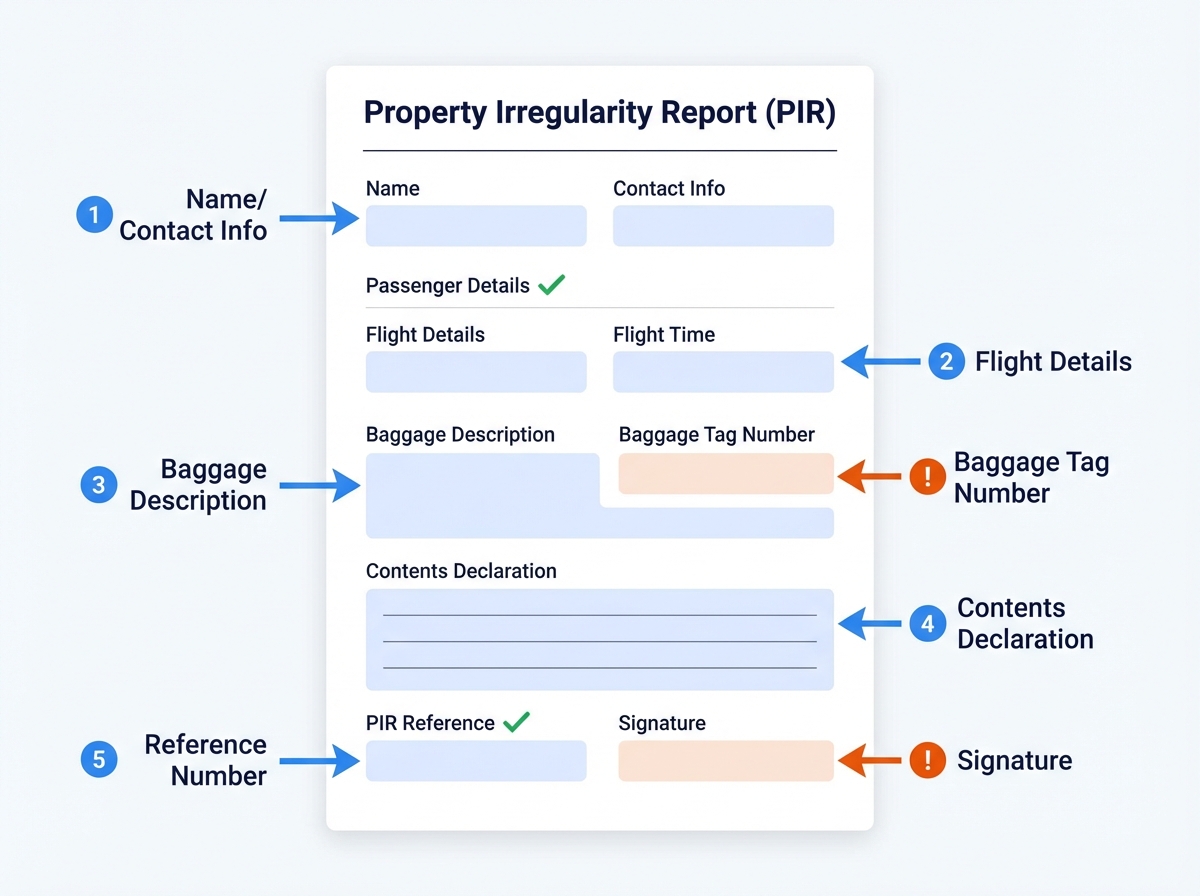
Layouts differ between airlines, but the fields are much the same. Use this table to check nothing is missing:
Example of a useful description: "Black Samsonite hard-shell, about 70cm, four wheels, red luggage strap, grey ribbon on the handle, ski jacket on top."
Can I file a PIR online or after leaving the airport?
Often yes. Many airlines let you report a delayed or damaged bag online or by phone, and some do it entirely through an online version of the tracing system. Do it the same day if you can.
Airlines set their own reporting windows. Aer Lingus, for example, asks passengers to report delayed baggage as soon as possible and within 7 days of travel. Check your airline's baggage page, and keep proof of when you reported (screenshot, email or call log).
If you left the airport without noticing damage, report it as soon as you see it and send a written complaint within the 7-day damage deadline.
How do I file a PIR for a damaged bag or missing items?
- Photograph the damage at the carousel, including the bag tag, before you leave.
- Show the bag to the desk staff and ask them to record each damaged part on the PIR.
- For missing items, list exactly what is missing and roughly what it was worth.
- Keep the damaged bag. The airline may want to inspect it or see a repair quote.
- Send a written claim within 7 days of receiving the bag, with photos, receipts or proof of value.
Our damaged baggage compensation guide explains what you can claim for repair or replacement.
What deadlines apply after I file a PIR?
The PIR itself has no legal deadline under the Montreal Convention, which covers almost all international flights, including those to and from Europe, the UK and North America. The written claim that follows does:
The maximum for most international flights is 1,519 SDR per passenger (about €1,840, US$2,060 or £1,540 at October 2026 exchange rates; the value moves daily). On US domestic flights, the minimum airline liability is US$4,700 per passenger, and reporting rules come from each airline's contract of carriage. Every time limit is listed in our baggage claim deadlines guide.
What happens after a PIR is filed?
- Tracing: the airline searches its network for the bag using your report. Follow progress with your reference, as explained in how to track a delayed bag.
- Update your file: add a contents list, a tracker location link or a new address if the airline asks or your plans change.
- Essentials: keep receipts for reasonable purchases such as toiletries and clothes. The airline is liable for proven losses caused by the delay, up to the limit.
- Delivery: once found, the bag is normally delivered to the address on your report.
- No bag after 21 days: it can be treated as lost. See our lost baggage guide.
On US flights, airlines must also refund the checked bag fee if a bag is significantly delayed, provided you filed a mishandled baggage report: more than 12 hours after a domestic arrival, or 15 hours (international flights of 12 hours or less) or 30 hours (longer flights).
What PIR mistakes should I avoid?
FAQs
Not sure what you can claim after filing your PIR? Check your claim for free.
Sources: ICAO (Montreal Convention limit), 14 CFR 254.4 (US domestic limit), US DOT refunds rule, Aer Lingus delayed baggage, British Airways baggage file reference. Last checked October 2026.