Key Takeaways
Click each item to mark as read
- 1✓
File a PIR before leaving the airport - it is the only official record of your baggage problem.
A Property Irregularity Report is the mandatory first step for any baggage claim. Without it, the airline has no formal record of the issue and can legally reject your claim outright.
- 2✓
Your PIR number is your case reference - photograph it immediately and keep it safe.
You will need your PIR number to track your bag online, follow up with the airline, and link your airport report to any compensation claim you submit later. Losing it slows everything down.
- 3✓
Describe your bag in detail - vague descriptions make it harder to find and match.
Instead of "black suitcase", include the brand, size, shell type, colour, and any distinguishing marks like stickers, straps, or scuffs. The more detail, the better the chance of a match.
- 4✓
Most delayed bags are returned within 24-72 hours - your PIR is what gets it moving.
The vast majority of missing bags are simply delayed, not lost. Filing a PIR enters your bag into the WorldTracer system, which connects airports and carriers globally to trace and return it.
- 5✓
After 21 days without your bag, it is officially lost and compensation rules change.
Until day 21, the case is treated as a delayed baggage claim. Once 21 days pass, the situation escalates to a lost baggage claim with different compensation rules and higher potential payouts.
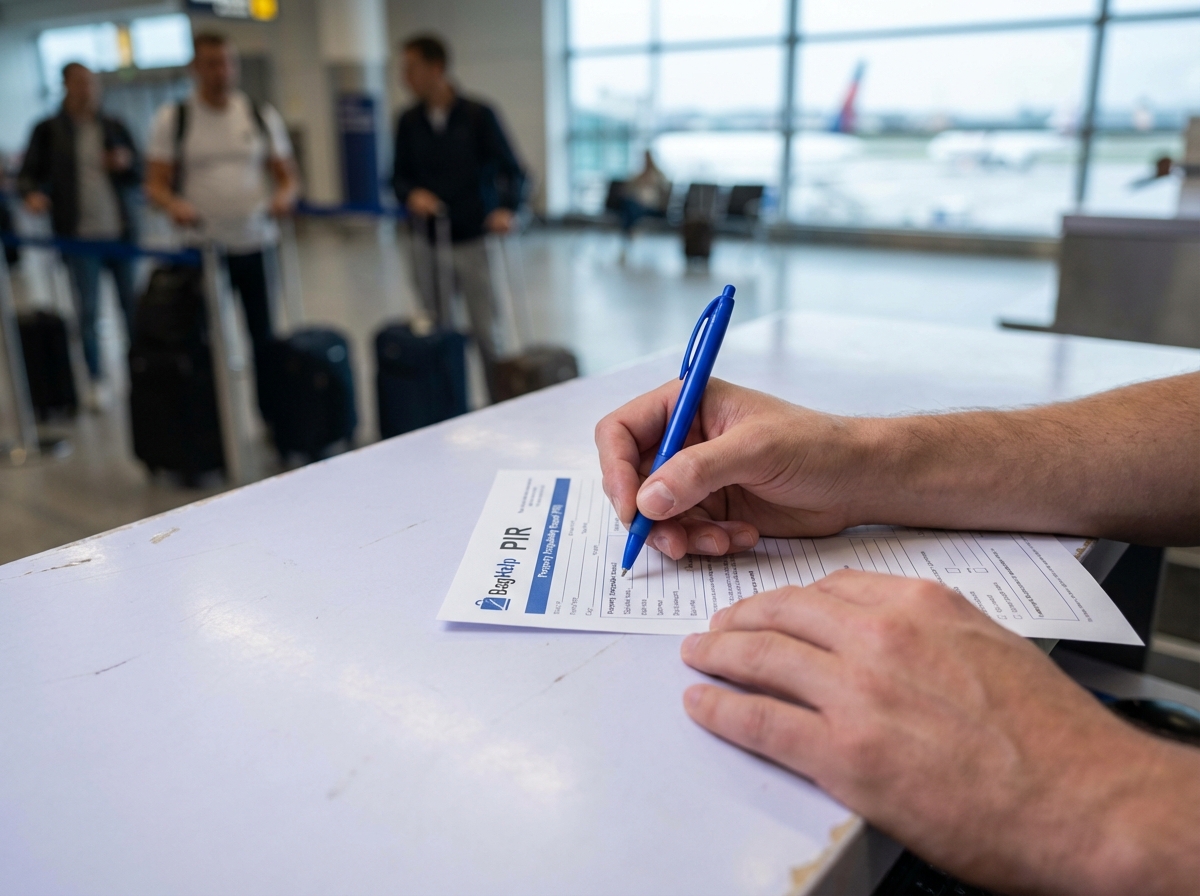
If your suitcase does not appear at baggage claim, or it arrives damaged, it is easy to feel stuck wondering what to do next. The answer is simpler than most passengers realise.
The very first thing to do is file a Property Irregularity Report, or PIR. This is the airline’s official record that something went wrong with your checked baggage, and it is what starts tracing, follow-up, and any later reimbursement process.
Without a PIR, your luggage is not properly logged in the baggage system. In practical terms, that means the airline has a weaker record of the issue and you have a much harder time proving what happened if you need to claim later.
Filing a PIR at the airport is the most important first step if your baggage is delayed, lost, damaged, or missing contents.
You should always report the issue before leaving the airport, because that gives the airline the best chance of tracing the bag quickly and avoids unnecessary disputes later.
Your PIR number matters just as much. It is the reference code you use to track the bag, follow up with the airline, and connect your airport report to any later claim.
Most delayed bags are found and returned within a few days, but the PIR is what gets your case into the system and moving.
If your bag is missing or damaged, go straight to the baggage service desk before you exit arrivals.
These documents let the airline confirm your checked bag and create a valid tracing record.
Give the brand, colour, size, shell type, and any unique marks that make the luggage easier to identify.
Photograph or screenshot the reference immediately, because you will need it for tracking and any later claim.
What is a Property Irregularity Report (PIR)?
A Property Irregularity Report is the document airlines use to officially record a problem with your checked baggage, whether it was delayed, missing, damaged, or tampered with.
Once you file a PIR, your case is entered into the airline’s baggage tracing system, usually WorldTracer. That is what allows the airline to start searching for your bag across airports and flights and link any later follow-up to the same case file.
When to file one
You should file a PIR as soon as you realise there is a problem with your luggage, ideally before you leave the airport.
This normally applies when:
- Your bag does not appear at the baggage reclaim area
- Your suitcase arrives but is clearly damaged
- Items are missing from inside your luggage
Even if you are tired, in a rush, or assuming the bag will turn up later, it is still worth taking a few extra minutes to report it properly while you are at the airport. It gives you the reference number, tracing file, and paper trail you will usually need if the case later turns into a reimbursement or compensation claim.
How to file a PIR at the airport

Head straight to the baggage services desk in the arrivals hall. This is usually near the baggage reclaim area and may be labelled "Lost & Found", "Baggage Services", or something similar.
Complete the PIR using your boarding pass, ID, and baggage tag. In some airports the report is digital, while in others it is still printed, but the essentials are the same. Double-check your phone number, email, and delivery address before you submit it.
Describe your luggage in as much detail as possible. Instead of writing "black suitcase", include the brand, size, material, hard or soft shell, and any stickers, ribbons, straps, or scuffs that make it easier to identify.
Once the report is submitted, you will receive a reference code. This is your PIR number, and it is what you use to track the case going forward.
What is a PIR number and why it matters
Your PIR number is a short code made up of letters and numbers, for example LHRBA12345. It is the reference number for your baggage case.
You will need it to:
- Check the status of your bag online
- Follow up with the airline
- Show proof that you reported the issue if you claim later
It is worth taking a photo of your PIR receipt or emailing it to yourself straight away. That makes follow-up much easier if the paper copy gets lost later.
What happens after you file a PIR
Once your report has been created, your bag is entered into the airline’s tracking system. Most airlines use a shared platform called WorldTracer, which connects airports and carriers worldwide. From that point on, the system starts trying to match your report with bags that have been found elsewhere in the network.
In many cases, bags are simply delayed rather than lost. They may have missed a connection or been loaded onto a later flight. When this happens, they are usually located and sent on to you within a few days. Once your bag is found, the airline will contact you and arrange delivery to the address you provided.
How long does it take to get your bag back?
Many delayed bags are returned within 24 to 72 hours, especially if they were left behind at the departure airport. More complex cases, involving missed connections, can take a few days or more.
If your bag hasn’t been located after 21 days, it is officially considered lost under international aviation law (see the Montreal Convention). At that point, the situation shifts from tracing to filing a claim for reimbursement and compensation.
Common mistakes to avoid
When something goes wrong with your baggage, it’s easy to rush through the process or assume things will sort themselves out.
One of the most common issues is leaving the airport without filing a PIR. Some airlines will let you make a report online, but doing it in person is always best.
Another is giving a vague description of your bag. The more detail you can provide, the easier it is for the system to match your bag if the tag is missing.
And finally, losing your PIR number can slow everything down. It’s worth saving it somewhere safe as soon as it’s given to you.
How different airlines handle PIRs
While the core process is generally the same, each airline handles reporting timelines and follow-up a little differently.
How major airlines handle the PIR
The key takeaway is that regardless of the airline, reporting the issue properly at the airport is always the first and most important step.
Just remember, a Property Irregularity Report is what gets everything moving. Once it’s done, your bag is in the system, your case is logged, and the airline can start working to resolve it. And without it, you’ll have a difficult time trying to make a claim for compensation.
Knowing what to do in those first few minutes at the airport makes a big difference, and often turns a confusing situation into one that’s much easier to manage.